A new academic year is getting underway in Delft, as thousands of new and returning students come back to campuses across the city.
For first-year students, the introduction has already begun. OWee, Delft’s general introduction week, brought together new bachelor students from TU Delft, The Hague University of Applied Sciences Delft and Inholland Delft. TU Delft also runs a separate Introduction Programme for incoming master’s, exchange and bridging students.
For Dutch students arriving from elsewhere in the Netherlands and international students moving to Delft from around the world, the first weeks are an opportunity to discover not only their studies, but the city, student associations, sports, culture and life beyond campus.
TU Delft at the heart of student life
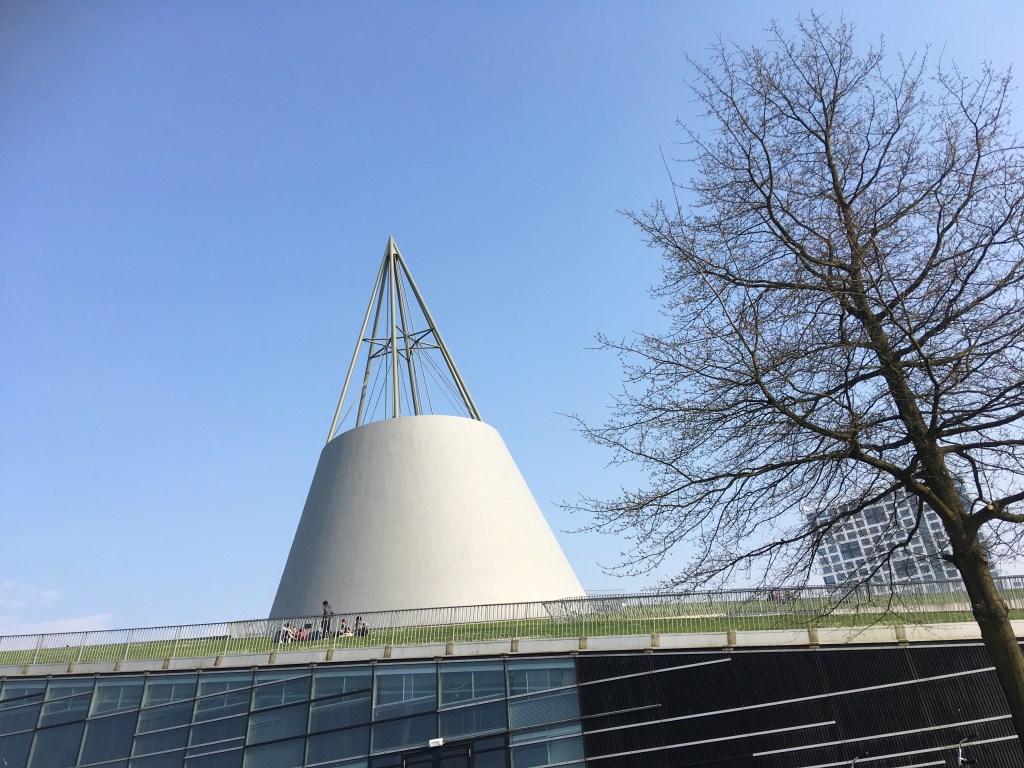
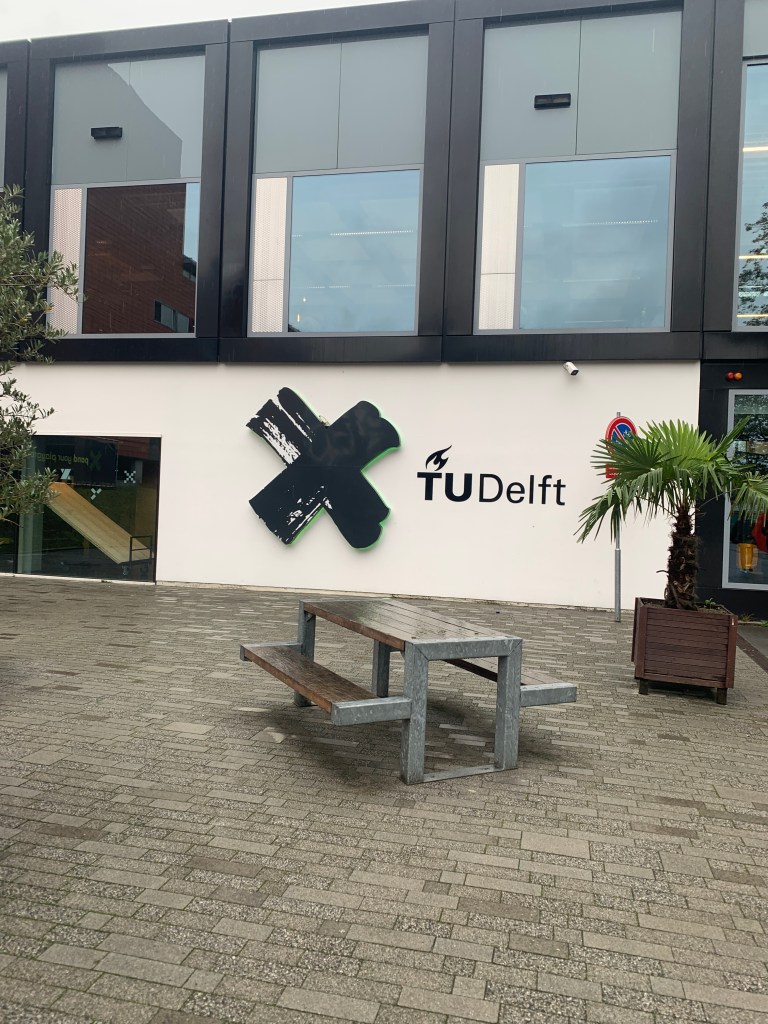
TU Delft is by far the largest higher education institution in the city and plays a major role in Delft’s identity as a centre for technology, research and innovation.
Around 3,500 students begin a TU Delft bachelor’s degree in a typical year. In 2025, 3,472 new bachelor students enrolled, an increase of 1.5 percent at a time when bachelor intake across Dutch universities fell by 3.4 percent.
Delft was also one of only a small number of Dutch universities to attract more international bachelor students. Around one quarter of its new bachelor students in 2025 came from outside the Netherlands, with Romania, Poland and Belgium among the largest international groups.
Dutch students remain the majority of the bachelor intake, while TU Delft becomes considerably more international at master’s, PhD and research level.
The university offers education and research across eight faculties, covering subjects including Aerospace Engineering, Architecture and the Built Environment, Civil Engineering and Geosciences, Electrical Engineering, Mathematics and Computer Science, Industrial Design Engineering, Applied Sciences, Technology, Policy and Management and Mechanical Engineering.
Mechanical Engineering remains particularly popular. In provisional 2025 figures, more than 900 new students were enrolled in the programme.
Delft’s international character also continues beyond graduation. Research published by Nuffic found that 38.7 percent of international graduates from Delft were still living in the Netherlands five years after graduating, one of the highest retention rates in the country.
OWee brings Delft’s students together
OWee is not only a TU Delft event.
New bachelor students from TU Delft, de Haagse Hogeschool Delft and Inholland Delft take part, giving students at the city’s research university and universities of applied sciences a shared introduction to Delft.
The programme includes student associations, sports and cultural organisations, information events and activities around the city and campus.
For TU Delft’s international master’s, exchange and bridging students, a separate Introduction Programme helps newcomers settle into university and life in the Netherlands.
Applied technology at THUAS Delft
De Haagse Hogeschool, internationally known as The Hague University of Applied Sciences or THUAS, has its Delft campus directly within the wider TU Delft campus area.
The location specialises in technology, engineering and IT and offers a more professionally oriented alternative to the research-university education at TU Delft.
Most programmes at the Delft campus are Dutch-taught. These include subjects such as Mechanical Engineering, Mechatronics, Engineering Physics, Applied Mathematics, Industrial Engineering and Management and Electrical Engineering.
Alongside these Dutch programmes, THUAS is expanding its English-language offering in Delft.
This academic year is the second year of its three-year English-taught Bachelor in Applied Computer Science. The programme started in September 2025 with around 40 students representing 25 different countries.
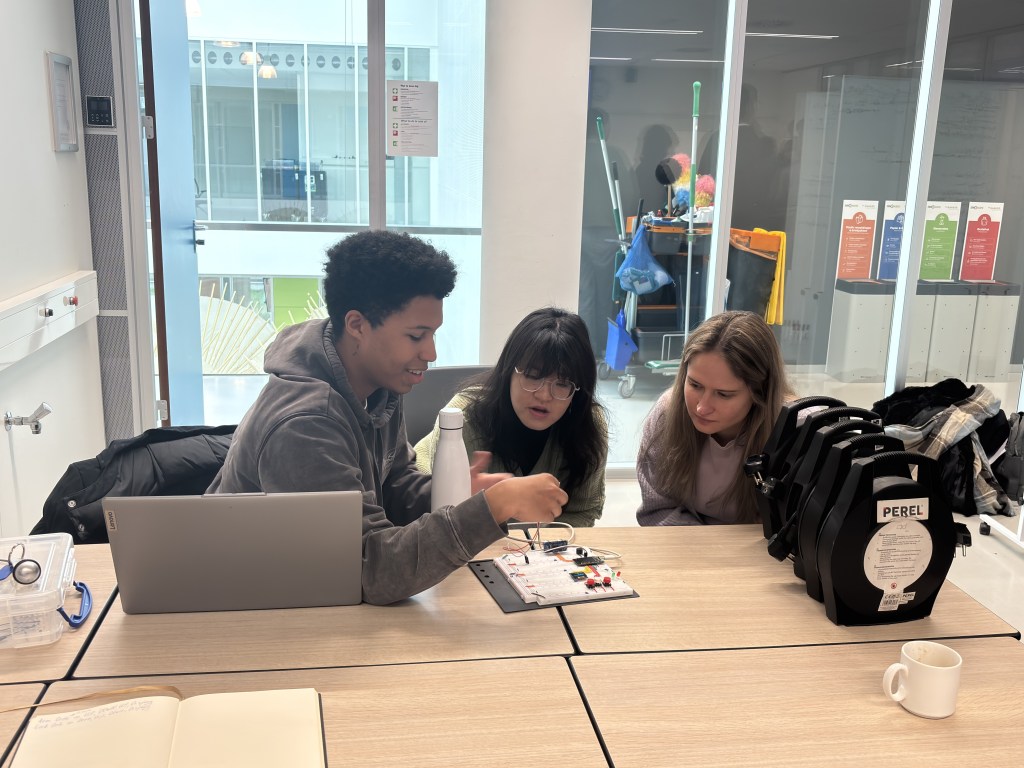
Applied Computer Science covers areas including programming, computer systems, cybersecurity, embedded systems, data science and responsible use of AI, with a strong emphasis on practical projects and collaboration with industry.
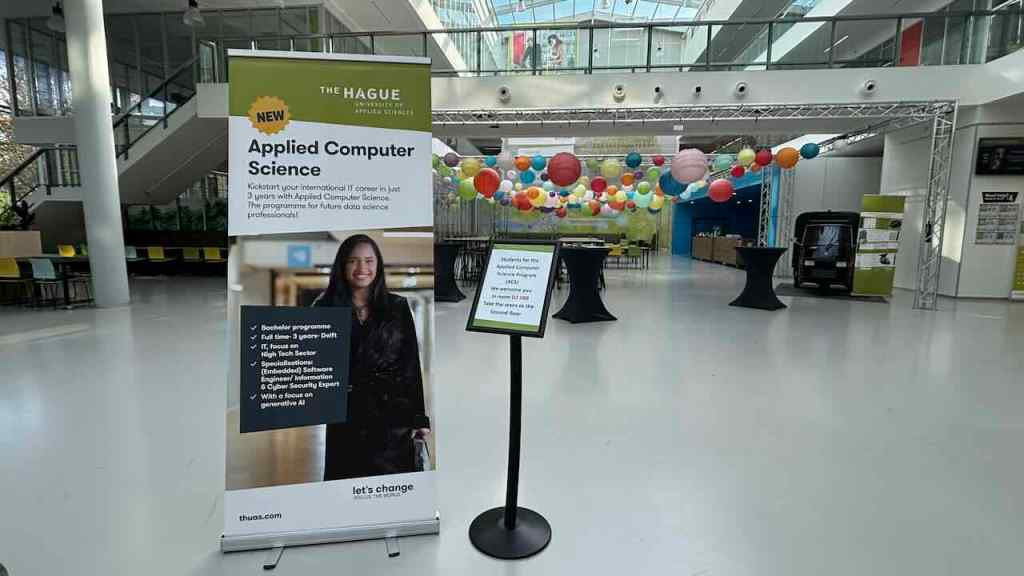
Delft Online’s sister site The Hague Online covered the launch of the programme last year:
A new English Electrical and Electronic Engineering programme
The international technology offering expands again this academic year with THUAS’s new three-year English-taught Bachelor in Electrical and Electronic Engineering.
The programme focuses on areas including microchips, sustainable energy, embedded systems and intelligent hardware, with students working on practical challenges and projects connected to the semiconductor industry.
Students who prefer to study in Dutch can also follow Electrical Engineering as a Dutch-language full-time or part-time degree.
The programme fits into a much broader development taking place around Delft’s semiconductor sector.
New cleanroom connects education and industry
In March 2026, THUAS officially opened a new educational cleanroom at its Delft campus, together with Mayor of Delft Alexander Pechtold.
The facility was created as part of the Beethoven South Holland programme, which brings together education, government and industry to address the growing demand for skilled workers in the semiconductor and microchip sector.
Cleanrooms are highly controlled environments used in industries such as semiconductor manufacturing. The new Delft facility allows students to gain practical experience with the conditions and equipment they are likely to encounter in the industry.
Importantly, the cleanroom is not intended only for THUAS students. It is available to students from vocational education, universities of applied sciences and research universities throughout South Holland, as well as employees working in the semiconductor industry.
The wider regional plan involves THUAS, TU Delft, Inholland, ROC Mondriaan and industry partners and aims to expand technology education and develop more skilled workers for the microchip sector.
The combination of the cleanroom, the new Electrical and Electronic Engineering programme and the second year of Applied Computer Science underlines the increasing focus on practical high-tech education at THUAS Delft.
Inholland Delft
Inholland University of Applied Sciences is another important part of Delft’s higher education community and also takes part in OWee.
Its Delft campus has a strong focus on technology, sustainability and the living environment.
For international students, its English-taught Bachelor in Aeronautical Engineering is particularly relevant, while Dutch-language programmes provide additional routes into applied technology and related fields.
Like THUAS, Inholland is a university of applied sciences, with an emphasis on practical education, projects and connections with employers.
More international education in Delft
Delft’s higher education landscape extends beyond the three institutions involved in OWee.
IHE Delft Institute for Water Education has a highly international postgraduate community and specialises in water and sustainable development.
Together with research institutes, startups and major technology companies in and around Delft, these institutions create a student and knowledge community that is unusually large and international for a city of Delft’s size.
Studying in Delft, in Dutch and English
Delft Online is an English-language platform, so we naturally focus strongly on information useful to international residents and students.
But Delft’s student community includes both Dutch and international students, studying alongside each other across the city.
For international newcomers, starting in Delft can also involve finding housing, registering with the municipality, arranging healthcare and banking and learning how everyday systems in the Netherlands work.
Dutch students arriving from another part of the country may have fewer administrative hurdles, but they are also building a new social network and discovering a new city.
Throughout the academic year, Delft Online will continue sharing English-language news, events and practical information to help both new and returning students discover more of Delft beyond their studies.
Welcome, and good luck with the new academic year!
Sources
TU Delft / Delta – Bachelor intake 2025
https://delta.tudelft.nl/en/article/unlike-other-universities-delft-attracts-more-students
TU Delft / Delta – International student numbers
https://delta.tudelft.nl/en/article/number-of-internationals-in-netherlands-drops-for-the-first-time-but-growth-in-delft
TU Delft / Delta – International graduates remaining in the Netherlands
https://delta.tudelft.nl/en/article/over-a-third-of-international-students-in-delft-stay-in-the-netherlands-after-they-graduate
OWee Delft
https://www.owee.info/
THUAS Delft Campus
https://www.thuas.com/about-thuas/contact/location-delft
THUAS Applied Computer Science
https://www.thuas.com/programmes/bachelors/applied-computer-science
The Hague Online – Applied Computer Science launch
https://thehagueonline.com/new-english-taught-applied-computer-science-bachelor-off-to-a-flying-start-thuas/
THUAS Electrical and Electronic Engineering
https://www.thuas.com/programmes/bachelors/electrical-and-electronic-engineering
THUAS – Delft cleanroom opening
https://www.thuas.com/about-thuas/cleanroom-open
THUAS – Beethoven South Holland programme
https://www.thuas.com/about-thuas/news/approval-delft-beethoven-plans-additional-technicians-microchip-sector
Inholland Delft
https://www.inholland.nl/inhollandcom/about-inholland/our-locations/
Images: Delft Online
 Delft Online
Leave a comment